You probe a chamber plate or precision carrier on the machining center, release the pallet, take it to the CMM—and the two coordinate sets disagree. What should you change first?
Not necessarily the zero-point receiver. The shift may come from the machine reference, a pallet joint, the adapter, fixture deflection, workpiece clamping, handling, temperature, or the CMM alignment. Buying a larger receiver does not fix a coordinate convention or a moving upper fixture.
The useful purchasing question is therefore not “What is the repeatability of the zero-point system?” It is: can the machining datum survive the complete handoff to inspection inside a limit we set before the trial? To answer that, separate repeat seating at one interface from station-to-station shift and finished-part variation.
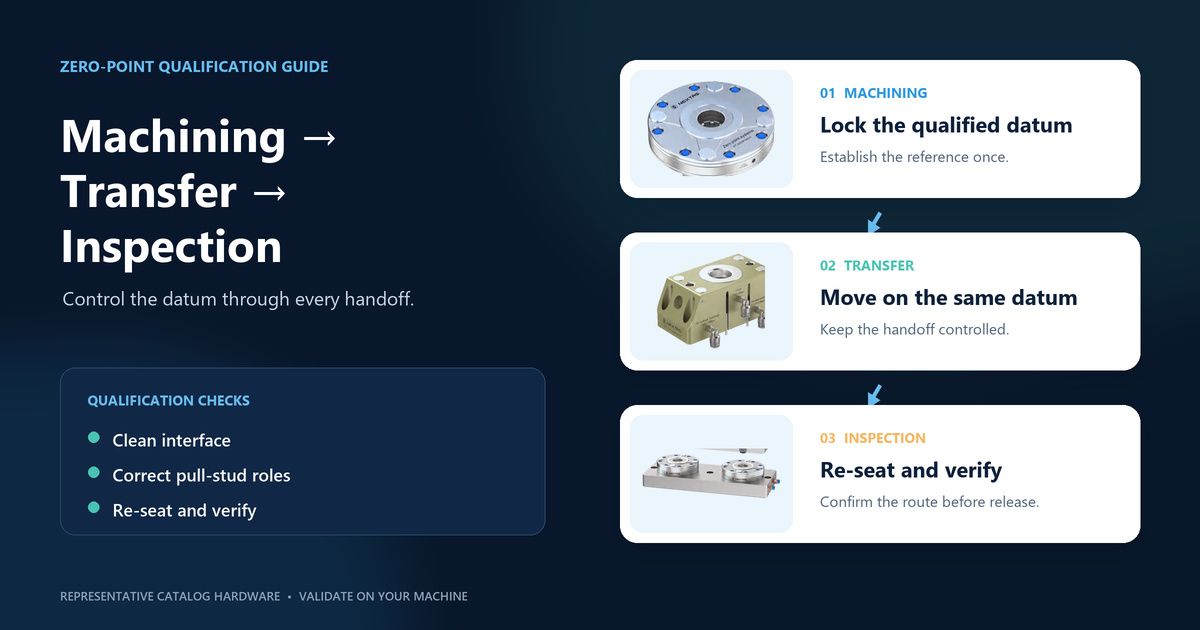
Which reference must survive the handoff?
Draw the real route before choosing receiver diameter: machining center → cleaning or transfer station → CMM → machining again if rework is allowed. Mark every point where the part, pallet, adapter, or fixture is lifted, unclamped, cleaned, probed, or re-aligned.
Then name the reference that must remain common. It could be a pallet datum, a qualified bore pattern, or a tooling-ball set agreed by manufacturing and quality. “Use the same zero” is too vague. The drawing revision, datum definition, axis directions, units, probe routine and transformation method need owners.
Ask three separate questions:
- Can one receiver reseat the same reference after a clean release and reload?
- Can two receivers or stations transfer that reference without an unacceptable offset?
- Does the complete stack—including the upper fixture and workpiece—hold the required feature relationship?
A pass on the first question proves neither of the others. That distinction is what turns a failed result into a useful diagnosis.
A catalog value covers one interface, not the process
The current NEXTAS catalog lists air-pressure unlocking, a mechanical self-locking structure, tapered positioning and several cleaning or air-check functions for the MFG receiver family. These are component features. The actual subplate, plumbing, pressure and flow at the module, sensors, wiring, PLC truth table and safe response still belong to the application.
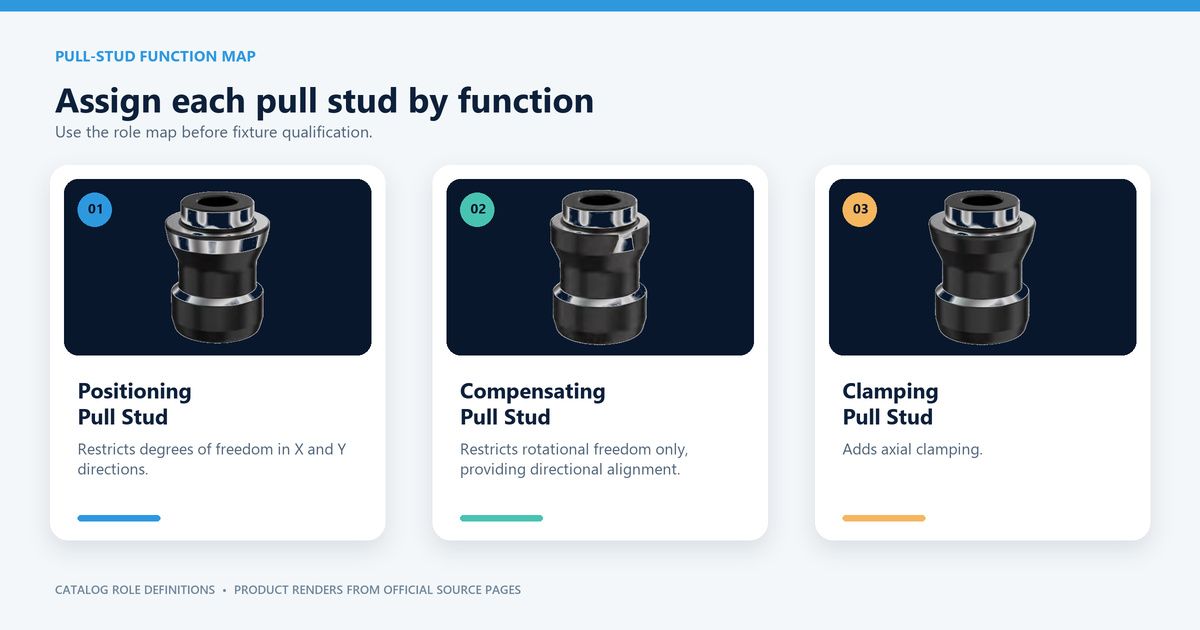
The pull studs also have different jobs. The positioning stud constrains X/Y, the compensating stud controls rotation without duplicating the full locating role, and the clamping stud adds axial clamping. Mixing those roles—or copying a pattern without the controlled drawing—can over-constrain the pallet or leave its intended datum undefined.
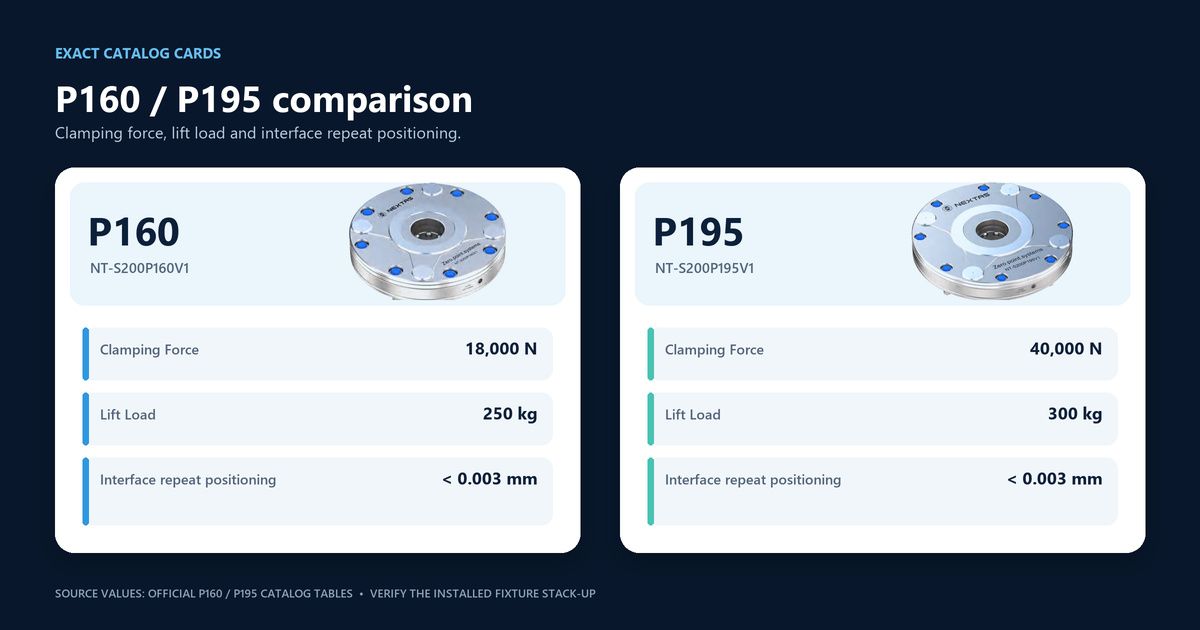
| Receiver model | Catalog mating-stud family | Clamping Force | Lift Load | Catalog repeat positioning |
|---|---|---|---|---|
| NT-S200P85V1 | P25 V1/V2/V3 | 4,000 N | 30 kg | <0.003 mm |
| NT-S200P120V1 | P30 | 12,000 N | 100 kg | <0.003 mm |
| NT-S200P160V1 | P35 | 18,000 N | 250 kg | <0.003 mm |
| NT-S200P195V1 | P40 | 40,000 N | 300 kg | <0.003 mm |
Keep the catalog labels intact. Clamping Force is the published field for the receiver interface; it is not workpiece clamping force or an allowable cutting load. Lift Load is not the permitted payload for your complete pallet. Center of gravity, overturning moment, orientation, dynamic handling, safety factor, pallet stiffness and machine limits still need review.
The <0.003 mm value is catalog interface repeat positioning. It does not include the machine, adapter, upper fixture, part, handling route or measurement system. Read the zero-point system family page for the product range, but request the current controlled drawing for the selected model before cutting a subplate.
Freeze the datum stack before hardware selection
Start with the drawing requirement and the CMM uncertainty, then work backward. Manufacturing and quality should assign the allowable datum-transfer variation; a supplier should not invent it from a receiver specification.
| Layer | What can move or disagree | Record before the trial |
|---|---|---|
| Machine reference | Axis geometry, thermal state, probe qualification and routine | Machine condition, warm-up state, probe check and program revision |
| Receiver interface | Contact condition, mating geometry, contamination and mounting | Receiver/stud IDs, cleaning method, clamp confirmation and drawing revision |
| Pallet and adapter | Flatness, joint movement, mounting error and unsupported span | Stack drawing, fastening method and inspection report |
| Upper fixture and part | Locator error, clamp sequence, deflection, burrs and distortion | Loaded stack, contact points, material state and clamp sequence |
| Transfer and CMM | Impact, temperature, fixture reference, alignment and uncertainty | Route, handling method, CMM program, probe status and uncertainty statement |
This ledger prevents the common—and expensive—response of replacing a receiver when the offset actually lives in the CMM fixture or software transform.
Run the clean-reload test before cutting
Start with a stable reference artifact or fixture feature, not a thin workpiece that can move under clamp load. Agree which directions matter—X, Y, Z and rotation—before anyone sees data.
- Record the receiver, studs, pallet, adapter, machine, probe, program and operator or cell mode.
- Inspect and clean the mating surfaces with the proposed production method.
- Load and clamp with the proposed pneumatic and control sequence; capture the defined clamp state.
- Measure the named reference without resetting the result to zero after every load.
- Fully release and remove the pallet so the interface is genuinely broken.
- Repeat for the agreed count, recording each result, temperature, interruption, alarm and rejected cycle—not only the average.
There is no universal reload count. Set it from process risk, the purpose of the study, operating modes and your quality system. Write the limit and the treatment of outliers before cycle one. If a dirty seat is excluded, keep it in the event log and state why.
A clean-reload pass supports the receiver portion of the chain. It still does not prove that the CNC and CMM share one physical coordinate relationship.
Now move the same reference from CNC to CMM
Use the production-intent pallet, adapter, fixture, handling method and datum definition. If the part will remain on one pallet, test that route. If it will be removed and located in a different inspection fixture, call it what it is: a second locating system with its own error sources.
Measure the reference at the CNC, release it, clean and handle it as production intends, then measure at the CMM. If return-to-machine recovery matters, send it back and measure the CNC station again. Do not re-zero after every move; that can erase the physical offset you came to find.
Keep the raw station coordinates as well as the calculated transfer delta. Confirm that both programs use the same axes, origin, sign, rotation, units and datum precedence. Record probe calibration and CMM uncertainty. A single unexplained “repeatability” result is not enough because it blends station offset, reseating, fixture movement and measurement uncertainty.
What the failure pattern tells you
| Observation | Look here first | Release decision |
|---|---|---|
| Clean-reload spread is unstable everywhere | Contact condition, mating parts, loading method, mounting or pneumatic sequence | Stop. Repeat the interface study under one agreed method. |
| One receiver differs while the others are stable | Local mounting, adapter, contamination or station geometry | Quarantine that station or hardware until the layer is isolated. |
| Clean-reload passes; CNC-to-CMM transfer fails | Coordinate convention, station mounting, CMM fixture, probing, temperature or handling | Do not change receiver size until the cross-station offset is located. |
| Error appears only with the part or cutting load | Upper-fixture deflection, workpiece distortion, support or load path | Treat it as a process-stack failure, not proof of receiver failure. |
| Clamp state is unknown or a dirty seat is missed | Sensing, air logic, cleaning, interlock and fault recovery | No unattended release without a safe, tested response. |
Change one variable at a time and keep the failed record. Deleting an awkward cycle removes the clue most likely to reappear on an unattended shift.
Turn the trial into an acceptance record
A useful record names the drawing, test route, hardware IDs, stations, programs, temperature, cleaning state, raw X/Y/Z/rotation values, transfer delta, alarms, recovery action, result and approver. It also says what triggers requalification: receiver replacement, pallet repair, fixture revision, machine relocation, CMM-program change or control-logic change.
For an automated cell, write the state table before commissioning. How does the PLC distinguish clamped, unclamped, unknown, cleaning failure, pressure fault and timeout? What blocks robot and spindle motion? What is the permitted recovery path? Sensor-ready hardware is not a validated control sequence. For more on actuation and cell logic, use the separate pneumatic zero-point plate guide.
The release gate should cover the drawing/interface review, single-station reseat, cross-station transfer, contamination recovery, representative load or cutting condition, automation fault states where applicable, and a production-intent part or pilot lot. Put the limit beside every gate before data arrives.
What to send for a useful review and quote
Send the smallest package that lets an engineer see the real chain:
- Part and datum: drawing, critical reference, material and the buyer-defined transfer allowance.
- Route: CNC, cleaning or transfer, CMM and any return-to-machine step.
- Stack: pallet, adapter, upper fixture, total mass, center of gravity, load direction and handling method.
- Interfaces: machine table or rotary drawing, available air routing, installed receiver or stud IDs, and any hardware that must remain.
- Acceptance: measurement method, reload plan, automation states, fault response and required handover record.
Ask for a datum-chain markup
Send those five inputs with the subject “Semiconductor datum transfer.” NEXTAS can mark the proposed interface chain, list the open geometry and control questions, and outline a reseat and cross-station test for review. Final performance remains subject to the agreed hardware, process and acceptance test.
Send the project details →Datum-transfer FAQ
Does <0.003 mm mean finished-part transfer accuracy?
No. The <0.003 mm value is the receiver-interface repeat-positioning specification under its catalog boundary. Finished-part transfer accuracy also depends on the machine reference, pallet and adapter, upper fixture, workpiece clamping and distortion, handling, temperature, probing strategy, CMM setup, and measurement uncertainty. Qualify the complete datum chain against a buyer-defined acceptance limit.
Can the same pallet go from CNC machining to CMM inspection without resetting?
It can be designed to do so when the pallet, receivers, adapters, datum definition, handling route, and inspection fixture are compatible. Prove that route with production-intent hardware and one coordinate convention. A software reset or new alignment can hide the physical transfer delta, so it should not be used as proof.
How many reload cycles should a qualification test include?
There is no universal count. Set the cycle plan from application risk, the required process capability, operating modes, expected maintenance interval, and the buyer's quality system. Define the count, acceptance limit, and treatment of interrupted or contaminated cycles before testing, and retain every event in the record.
Which receiver size should we choose?
Choose from the exact interface geometry, pallet and fixture stack, load direction, moment, center of gravity, orientation, dynamic handling, required Clamping Force field, and air-routing constraints. The catalog Lift Load is not a complete allowable application payload. Model selection requires an engineering review of the full assembly and operating condition.
Do we need sensors for an automated cell?
Define how the cell will distinguish clamped, unclamped, unknown, and fault states, and how interlocks will prevent robot or machine motion when confirmation is missing. Also define contamination response, pressure faults, timeouts, and recovery. Sensor-ready hardware does not mean the complete sensing, control logic, wiring, diagnostics, and safe recovery sequence has been validated.
Catalog note: Model fields in this guide are taken from the NEXTAS 2026 quick-change clamping catalog. Confirm the current quotation, controlled drawing and project-specific test plan together before ordering. For application context, see semiconductor manufacturing workholding.